


Welcome to the ninth issue of Metrix that Matter, a weekly newsletter from WEALTHMETRIX that helps you focus on what matters most for building and sustaining wealth. Every Saturday, we share an educational essay with actionable takeaways to guide you on your journey to financial independence.
What you’ll learn in this issue:
- The different types of qualified accounts
- Three tax benefits of qualified accounts
- The tradeoffs of contributing to qualified accounts
- Three common mistakes
- Balancing liquid and qualified savings
Retirement is likely the largest financial goal you will ever have in your life.
Think about it… You need to accumulate enough wealth to potentially sustain 20-30 years of living expenses without a paycheck. That makes it bigger than buying a house, funding your kids' education, or any other major purchase you'll make.
Yet, despite its massive scale, many people approach retirement savings haphazardly. They accept default retirement plan options, underutilize the benefits available to them, and lose track of old accounts along the way.
When the stakes are this high, you can't afford to be anything but intentional about your approach.
Last week, we talked about the importance of liquidity in your finances, but that’s only one half of your savings strategy. Today, we’re going to talk about the other half: qualified accounts.
Qualified accounts aren’t just for retirement
Qualified accounts are exactly as they sound. You have to meet certain qualifications to contribute to these accounts and you have to meet certain qualifications to withdraw from these accounts. In exchange, the IRS provides valuable tax benefits.
While there are dozens of account types with various acronyms, they all serve one of three core purposes:
Retirement
The most common types of qualified accounts. Traditional and Roth IRA, 401(k), 403(b), 457(b). These all exist to help you accumulate wealth for life after work.
Education
Designed to help families save for education expenses, 529 Plans have become increasingly flexible in recent years, making them powerful tools for multi-generational education planning.
Healthcare
Perhaps the most underutilized qualified account, Health Savings Accounts (HSA) offer a unique triple tax advantage when used for medical expenses.
Three potential tax benefits
What makes these accounts so attractive? They can offer up to three distinct tax advantages:
Tax deductions for contributions
With traditional retirement accounts and HSAs, you can deduct your contributions from your taxable income today, lowering your current tax bill.
No taxes owed while it grows
Unlike liquid accounts, these accounts grow without the drag of annual taxes on dividends, interest, or capital gains. This seemingly small benefit compounds dramatically over decades.
Tax-free qualified withdrawals
Roth accounts, 529 Plans, and HSAs allow you to pull money out completely tax-free when used for their qualified purposes.
The price of admission
But these tax benefits don't come without limitations. The government sets strict rules about who can contribute, how much they can contribute, and when they can access their money without penalties.
While each account has its own set of rules, the key is understanding that these restrictions exist for a reason: to ensure you use the accounts for their intended long-term purposes. When used correctly, the tax benefits can far outweigh the limitations.
Qualified accounts aren't just about reducing taxes, but rather about creating dedicated pools of money for life's biggest expenses. By understanding and maximizing these accounts, you're building the foundation for financial security in retirement, your children's education, and your family's healthcare needs.
Three common mistakes
Even with the best intentions, I see smart people making the same three mistakes with their qualified accounts year after year. These are simple oversights that compound into significant lost opportunities over time.
Mistake #1: Leaving free money on the table
Most people know about 401(k) matching, but even those who capture their full retirement match often miss other employer benefits. The most overlooked? Health Savings Account (HSA) matching.
Many employers who offer high-deductible health plans also contribute to employee HSAs, either through a matching lump sum or contributions throughout the year. Yet, I regularly meet clients who've never opened their HSA, let alone captured the match. They're so focused on their 401(k) that they miss this second pot of free money.
Mistake #2: The set-it-and-forget-it trap
Contributing to qualified accounts is only step one. Next, you need to invest the money.
I routinely see accounts with tens of thousands of dollars unintentionally sitting in money market funds earning next to nothing, sometimes for years.
If you are contributing to an employer plan, there is likely a default investment option that your money will automatically go into if you don’t make any changes. While some defaults are reasonable (like target-date funds), others park your money in stable value or money market funds that barely keep pace with inflation.
If you are contributing to qualified accounts outside of your employer, such as an IRA, you will need to invest those funds yourself.
Mistake #3: Neglecting old accounts
The average American will change jobs several times over their career. That could mean several different 401(k) accounts scattered across various providers, each with its own fees, investment options, and statements.
It is not uncommon to see people with three or four forgotten 401(k) accounts from previous employers. The longer you wait to take care of these accounts, the harder it becomes to track them down.
These three mistakes share a common thread: they're passive, not active ones. Most people don’t deliberately decide to forfeit employer matching or leave money in cash. These things happen through inaction, or by just accepting the defaults rather than creating an intentional plan.
Balancing liquid and qualified savings
The right balance between liquid and qualified savings shifts throughout your life. Early in your career, you may need more liquidity for major purchases, career pivots, and building your emergency fund. As you enter your peak earning years with more stability, you may be able to stash away more in qualified accounts. Approaching retirement, you may need to rebuild liquidity to create flexibility in those critical transition years.
The families who achieve true financial flexibility understand that wealth isn't just about how much you have saved, but about having the right money in the right places. Build a strong foundation in both liquid and qualified accounts. Neither should be ignored, and neither should dominate your entire financial picture. Balance is what gives you options when life happens.
WHAT TO FOCUS ON THIS WEEK
This week, I want you to calculate your Qualified Term, a simple metric that reveals whether you're on track with your retirement savings or need to shift your focus. This score shows how many years your current qualified assets could cover your current living expenses. Here's the formula:
Qualified Term = Total Qualified Assets ÷ Annual Living Expenses
Your qualified assets include:
- Traditional and Roth IRAs
- 401(k), 403(b), 457(b) accounts
- 529 education savings plans
- Health Savings Accounts (HSAs)
Let's walk through an example. Say you have:
- $150,000 in your 401(k)
- $50,000 in a Roth IRA
- $25,000 in an HSA
- $100,000 in annual living expenses
Your Qualified Term would be: ($150,000 + $50,000 + $25,000) ÷ $100,000 = 2.25
This means your qualified assets could theoretically cover 2.25 years of expenses.
Take 10 minutes this week to add up all your qualified accounts and calculate your Qualified Term. Then ask yourself: Does this balance with my liquid savings? Am I prepared for both my near-term needs AND my long-term retirement goals? The answer will guide your savings priorities for the year ahead.
ELEMENTS INVITATION
Thank you for reading. Understanding the metrics that matter for your wealth requires more than tracking individual pieces. You need to see how everything works together. That’s what Elements is designed to help you do.
Elements is a financial planning tool that organizes all your financial information in one place, then calculates the 11 key metrics that truly matter for building wealth. You'll see not just where you stand today, but how each metric relates to the others and impacts your overall financial trajectory.
Most importantly, Elements empowers you to make better financial decisions. When you understand how all the pieces fit together, the path to financial independence becomes much clearer.
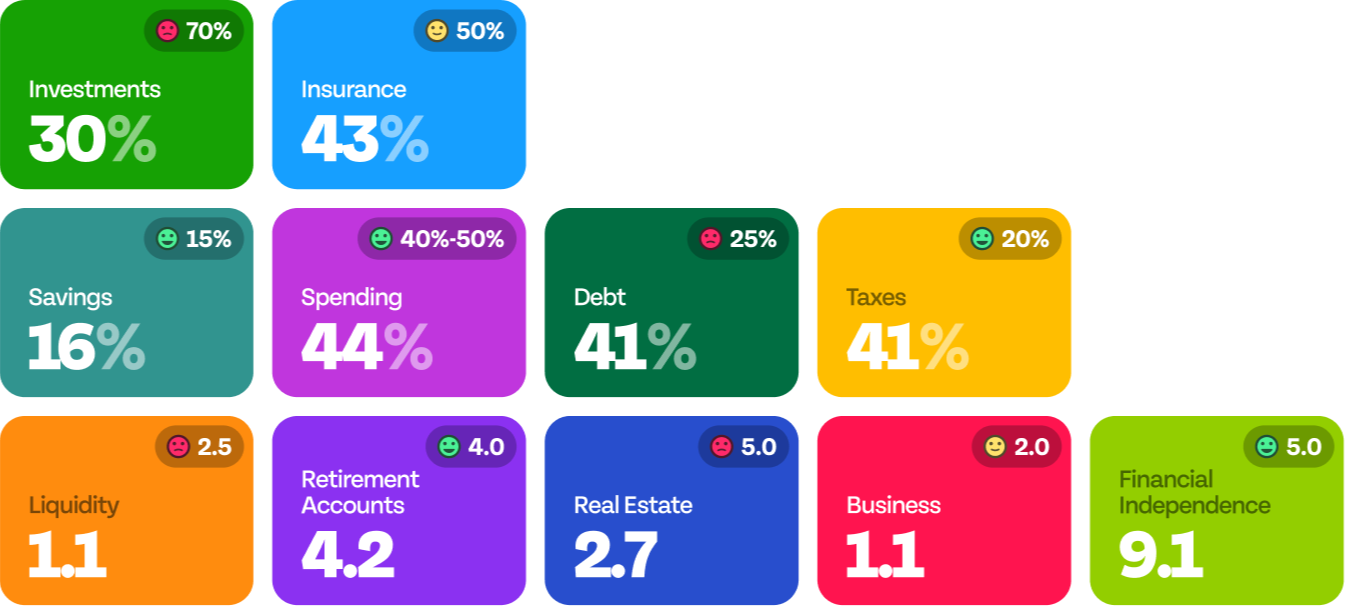
If you're ready to gain this level of clarity and control over your financial situation, click the link below to get started with Elements. You'll answer basic questions about your income, spending, debt, and account values. The whole process takes about 10 minutes.
Once complete, we'll review your personalized scorecard and send you an email to schedule a complimentary 30-minute call to discuss your situation, answer any questions, and explore whether there's a fit to work together.
GET YOUR FINANCIAL SCORECARD IN 10 MINUTES
ALREADY SIGNED UP FOR ELEMENTS? CLICK HERE TO LOGIN
WEALTHMETRIX
https://www.mywealthmetrix.com/
(972) 267-7526
102 S. Goliad Street, Suite 101
Rockwall, TX 75087
16475 Dallas Parkway, Suite 840
Addison, TX 75001
Securities offered through Cetera Wealth Services LLC, member FINRA/SIPC. Advisory services offered through Cetera Investment Advisers LLC, a registered investment adviser. Cetera is under separate ownership from any other named entity.
For a comprehensive review of your personal situation, always consult with a tax or legal advisor. Neither Cetera Wealth Services LLC nor any of its representatives may give legal or tax advice.
The views stated are not necessarily the opinion of Cetera and should not be construed directly or indirectly as an offer to buy or sell any securities mentioned herein. Due to volatility within the markets mentioned, opinions are subject to change without notice. Information is based on sources believed to be reliable; however, their accuracy or completeness cannot be guaranteed. Past performance does not guarantee future results.
Advisory services may only be offered by Investment Adviser Representatives in connection with an appropriate Cetera Investment Advisers LLC Advisory Services Agreement and disclosure brochure as provided. The output of any financial tool or calculator without such an agreement should be considered to be a part of our brokerage services and not advisory services.
Distributions from traditional IRAs and employer-sponsored retirement plans are taxed as ordinary income and, if taken prior to reaching age 59 ½, may be subject to an additional 10% IRS tax penalty. Roth IRA: converting from a traditional IRA to a Roth IRA is a taxable event. A Roth IRA offers tax-free withdrawals on taxable contributions. To qualify for the tax-free and penalty-free withdrawal of earnings, a Roth IRA must be in place for at least five tax years, and the distribution must take place after age 59 ½ or due to death, disability, or a first-time home purchase (up to a $10,000 lifetime maximum). Depending on state law, Roth IRA distributions may be subject to state taxes.
All investing involves risk, including the possible loss of principal. There is no assurance that any investment strategy will be successful.